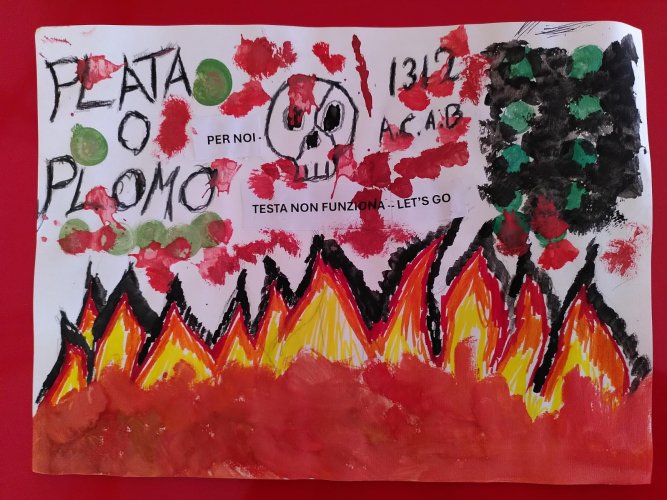
Shadows Behind the Bars
Reflections by Linda, a youth worker, on her work in prisons in Italy and Latvia.
October 2025, Terni, Italy
It still felt a bit strange, but I’d already got myself ready – to get to our classroom, there were several corridors to walk through, where the inmates were also going about their business. Everyone greets each other politely. As I approach my destination, I make my way through the cigarette smoke. Literally – I wave my arms in a butterfly-style motion.
A chaotic half-hour begins, during which we try to work out which boys will be taking part in the session. Whilst the security guard rings the relevant departments to call in the missing boys – who make up the largest part of the group – the two who have already arrived volunteer to go and fetch the others. We try to persuade them to stay, as it’s clear that they, too, will most likely disappear. And not because they don’t want to take part. They simply have no sense of time. This is partly because most of them don’t have jobs in prison, and there aren’t many other activities on offer, so they simply drift through the days; and partly because they’re quite drugged. The next shock. At first, it seemed that the guys had left a fair bit of their health – including their mental health – out on the streets, which is why they’re now quite apathetic. However, it soon became clear that, instead of being imprisoned, the boys were receiving methadone treatment. I never did find an answer as to whether everyone actually needed it. Sometimes someone would be completely out of it, and his greeting would be ‘testagira’ (my head’s spinning), and in another session the same lad would be lively and active, albeit rather critical of everything. But alive, full of life. In the next session, he’s quiet again, finds it hard to concentrate, and everything has to be repeated several times. What creative writing, Linda! What self-analysis and goal-setting. Let’s just simply try to talk and understand one another.
It is interesting, though, to consider how one can communicate when imprisoned in a country whose language one does not speak. A large proportion of the participants in our sessions were young men born outside Italy, and indeed outside Europe. No, immigrants are not criminals. Yes, people who come from elsewhere are at a much greater risk of ending up in the criminal world if they lack the necessary support. Take Spain, for example. Statistics show that the average age at which a young Spaniard becomes financially independent is 29. This is a young person who has a family, who lives in their own country, with their own language and culture. Most likely, a young person with an education. And then there are children who have arrived as refugees from Ghana, Tunisia, the Dominican Republic, and young people from Brazil, Pakistan, and so on. They’ll be looked after until they reach adulthood. They’ll have a place to live, food to eat, clothes to wear, and people who’ll encourage them to get an education. At the age of 18 – bye, off you go, look after yourself, find a job, even if you still don’t have a visa or even a residence permit. Then the prison statistics don’t seem so surprising anymore. So – in our group we speak English and Italian, and the guys also chat amongst themselves in their native languages. A pretty diverse bunch we are. We finally decide to start with those who have turned up. During the lesson, someone else shows up. We manage to get through a quarter – or even less – of what we’d planned. And so it goes, every time. Change? Impact? I don’t know. Someone learnt about Latvia’s existence. Someone had the chance to be useful, tidying up the classroom or translating what others were saying for me. Someone held coloured pencils in their hand again after a 15-year break. Someone learnt six words of Italian together with me. Someone wondered – why on earth are they spending time coming to see me at all?
July 2026, Liepaja, Latvia
The new prison. A maze – I still haven’t memorised the route they’re taking us along for the umpteenth time. Bright, with colourful accents. Still a bit bleak, uninhabited, quiet. The sports hall is more pleasant. We put away the juggling equipment and go through the day’s plan. Meanwhile, the young people are brought in. We start the session. Everyone’s as clear as crystal. All white, locals. A few are a bit rowdy. Distrust, resistance, sniggering. But at least they’re here, with us. That’s actually very good for a start. Oh, no, what games. Throwing balls? Easy. Well, if it’s easy, show us. Ah, it’s not quite working yet. Try it this way – it helped me when I was learning.
And I am still learning.
Linda
The youth workers' mobility "Shadows Behind the Bars" is financed by the Erasmus+ Programme of the European Union that in Latvia is administered by The Agency for International Projects for Youth. This publication reflects only the viewpoint of the author.