“Gaming for climate chanCe” youth exchange in Portugal
In the heat of August, five young people from Liepāja – Karlīna, Paula, Viljams, Amanda and Roberts – spent a week in the Portuguese town of Amarante, taking part in the international youth exchange “Gaming for climate chanCe”.
Karlīna shares her impressions of this experience:
Whilst I didn’t really know what to expect at first, on returning home I realised that this trip had given me much more than I’d initially anticipated.
One of the things I enjoyed most about this week was definitely the people. It was really interesting to meet new people from different countries and learn more about their culture, daily lives and experiences. Although we were all quite different, the group activities very quickly helped us to feel more at ease and comfortable with one another. The team tasks, in particular, were very helpful, as they required us to communicate, find solutions together and work as a team.

William and Amanda, along with others get to know Amaranti
I also found the project’s theme very useful. Over the course of the week, I learnt a lot of new things about how our everyday choices affect the environment and what we can do to live in a way that’s a little more considerate of nature. I liked the fact that we didn’t just discuss these topics in theory, but learnt a great deal through various activities and practical tasks. It also made me reflect on my own daily habits and what I could do differently in the future.


Of course, the week had its challenges too. As each day had a packed programme of activities starting at specific times, you could feel the tiredness setting in quite quickly. On the one hand, it was great that there was always something going on and it wasn’t boring, but, on the other hand, after several intense days, I just wanted to have a proper sleep. The two-hour time difference between Latvia and Portugal also threw my usual routine off a bit at first.
One of the things that made this experience a little difficult for me was the language barrier. To be honest, I was quite surprised that many of the Italian participants knew very little or almost no English. As we were all from different countries in the project, English was the main way we communicated with one another, so it was sometimes difficult to hold a simple conversation or express my thoughts quickly. Of course, everyone tried to help one another, and often someone would step in to translate, but this took quite a lot of time. This was particularly noticeable during group activities, such as when playing board games. The games themselves were very interesting, and, in my opinion, they would have been even more fun if everyone could have understood one another freely. However, a large part of the time was often spent on interpreting for one another. First, someone would explain something in English, then it would be translated into Italian, and only then could we continue with the game. This disrupted the flow of the activities a little and made communication more difficult, but at the same time it also showed just how important patience, understanding and the willingness to find a way to communicate are, even when we don’t speak the same language. It was certainly one of the biggest challenges of the week, but also an interesting part of the intercultural experience.

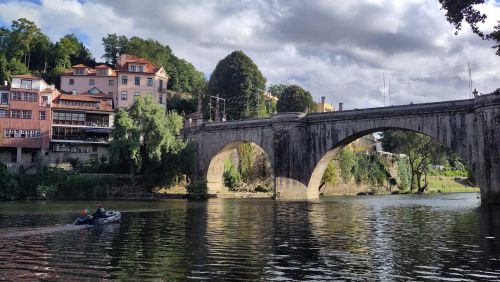
I really liked Portugal itself. Amarante was an incredibly beautiful town – peaceful, with lovely views, a river, old buildings and a very special atmosphere. In general, Portugal seemed very beautiful and quite different from what I’m used to in Latvia. The only thing is, there really is no shortage of hills there! At times, walking up the hills in the heat, it felt as though I was about to run out of energy.
I really liked Porto too. It had a completely different atmosphere – far more people, hustle and bustle, and city life. It was interesting just to walk around the city, take in the surroundings and experience everyday life in Portugal. Overall, the people in Portugal also seemed very friendly and welcoming, which made the trip even more enjoyable.
I’d also like to mention the food, as it pleasantly surprised me. There were gluten-free and vegan options available, and they were really delicious! The only thing was that having rice for lunch every day for vegans and those on a gluten-free diet was a bit of a let-down, but apart from that, everything was brilliant. It was great that they’d thought of this and we didn’t have to worry that something wouldn’t be suitable. The communal meals were also a lovely time when we could just chat, have a laugh and spend time together.
It’s just a bit of a shame that on the last day we didn’t manage to cook our traditional dish and show the others a bit of Latvian cuisine. On the other hand, it was really great to sample traditional dishes from other countries and, of course, from Portugal. The only thing is, I still can’t quite work out whether the Italians had gone a bit overboard with the seasoning and added quite a lot of salt, or whether Italians simply do like their food that salty.

Robert in Porto
For his part, Roberts shares his thoughts on the project’s main planned outcome – educational games for young people on climate change, which are being developed in both analogue and digital formats. He had previously played the analogue version of the game-in-development alongside other young Latvians, and it was retested during the exchange:
Whilst playing, we realised that the game needs to be less formal; it lacks engaging elements – something artistic, perhaps. Similarly, the English used in the game seems too complicated. If it is intended for young people, then many things should be rephrased in simpler, more understandable language. The rules of the game should also be clearer. It would also be interesting if the game included some fantasy role-playing elements, something similar to ‘Dungeons and Dragons’. The basic concept of the game is very good, but it needs to be rethought to ensure it is specifically suited to young people. It’s great that the game’s design includes a reference to the Erasmus+ programme, as this encourages young people to take advantage of the opportunities the programme offers.
The project was coordinated by InformaGiovani in collaboration with Share Europe (Bulgaria), Equação (Portugal), Radi Vidi Pats (Latvia) and Ambitia (Slovenia).
The activity was part of the ‘Gaming for climate chanCe’ project (2024-2-IT03-KA220-YOU-000281264), co-funded by the European Union under the Erasmus+
#ErasmusPlus #GiveClimateAChance #RadiVidiPats #ClimateAction #YouthParticipation #NonFormalEducation