Across walls, through words: hosting youth workers in Terni Prison
When our association Demetra in Terni was invited to host youth workers for a job shadowing experience connected to prison education, the proposal immediately touched a field that is very close to us and at the same time still in transformation. For years, Demetra has been working with people in detention and with those at risk of social exclusion, inside and outside the prison, through social agriculture, bread‑making and pastry projects, as well as by including participants in the creative activities of the association. Hosting Linda Ulāne from Latvia and Marco Marinelli from Bologna offered the chance to open this experience to an international perspective and to experiment with new educational tools that could inspire future projects.
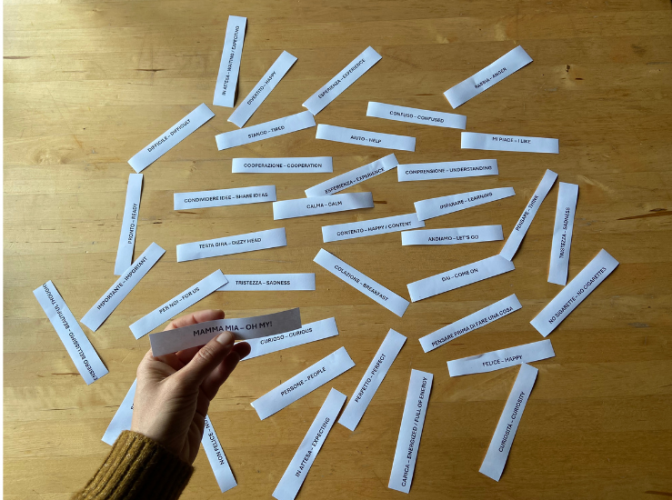
The job shadowing took place in the men’s prison of Terni, which also hosts a young adult population. Our focus was not on bringing a “spectacular” form of participatory art inside, but on testing simple non‑formal education methods that could support connection, expression and reflection. One of the threads running through the whole period was a very small ritual: at the beginning of each session, everyone was invited to share one word about how they were arriving; at the end, one word about how they were leaving and what they were taking with them. This one‑word check‑in and check‑out, repeated over time, created a gentle continuity between meetings and made it easier for participants to notice shifts in their emotional landscape, even on days when energy or concentration were low.
Initially, our intention was to work directly in the prison library, turning it into the main space for the “Bridges of Words” workshops. However, for organisational reasons this was not possible, and many aspects of planning activities in the Terni prison turned out to be more complex than expected. Even so, visiting the library together was meaningful: in books, reading and writing we recognised a shared passion that links our work in Italy with Linda’s long‑term engagement in Latvia. From the beginning, the idea of “Bridges of Words” was not a fixed set of activities, but an exploration of how language, stories and small creative gestures can build bridges between very different contexts. Designing and debriefing the sessions together, switching between Italian and English, forced us to slow down and to put into words what usually remains intuitive in our practice.
For Demetra, the main benefit of hosting youth workers in this prison‑related project was precisely this space for experimentation. Our previous projects in Terni prison – from social agriculture to the reopening of the bakery and pastry workshop – have shown us the power of working with hands, rhythms and concrete products that can be shared with the city. The job shadowing invited us to ask how similar principles could be translated into activities centred on language, imagination and group processes. It was not about adding “more work” to an already complex context, but about taking the time to observe, to test and to imagine together what future initiatives could look like.
During the job shadowing, it was also important that Linda and Marco did not limit their presence to the prison setting. They took part in several activities outside the institution, offering their competences to other youth and social workers in Terni. This wider involvement allowed local practitioners to meet new methods, questions and perspectives, and helped Linda and Marco to see how our work with people in detention is connected to broader community‑based initiatives.
Another meaningful element was the chance to meet the prison educators and staff, and to share experiences from Latvia, from other Italian contexts and from Demetra’s projects. These conversations did not always lead to immediate changes, but they opened space for mutual recognition and for widening our points of view on what education in prison can be – and on how different actors can cooperate to make it happen.
Of course, the experience also brought challenges. Working in a large men’s prison means dealing with strict schedules, last‑minute changes and the emotional weight that prisoners and staff carry every day. Some sessions felt fragmented; sometimes it was difficult to reconcile the expectations of an international project with the reality of the department we were entering. In those moments, it was important to keep the job shadowing honest: sharing doubts, naming frustrations and accepting that experimentation includes days where the impact is not immediately visible.
Still, what remains strongest from this period is the sense that hosting youth workers in such a context can widen the horizon for everyone involved. For Linda and Marco, Terni became a place where their skills in youth work, writing and circus could meet a very specific institutional frame and be reshaped by it. For Demetra, it was a chance to look again at our own experience with people in prison, to connect it with international conversations, and to plant the seeds of future projects. In this sense, “Bridges of Words” has been less a finished project and more a beginning: a small but important step in imagining how youth work and prison work in Europe can learn from each other.
Caterina Moroni
artist, trainer and project manager for Demetra APS
www.associazionedemetra.it
www.caterinamoroni.it
The youth workers' mobility "Bridges of Words" is financed by the Erasmus+ Programme of the European Union that in Latvia is administered by The Agency for International Projects for Youth. This publication reflects only the viewpoint of the author.