What is working in prison?
To begin with, I’d like to share a little about another project I’ve been working on, one that isn’t related to prisons. It was a two-year project on the wellbeing of youth workers. Ever since I experienced professional burnout in 2016, and following a near-burnout during the post-Covid period, this has been a topic I’ve tried to include regularly in youth worker trainings. For several years, this was my mission. I was therefore delighted to have the opportunity to work on a larger-scale project on wellbeing. This project had two thematic strands – wellbeing and advocacy – which, to be honest, didn’t particularly interest me at first. That was until, whilst interviewing those involved in the field, it became so clear that setting personal boundaries and the ability to look after oneself are important, but that breathing exercises and learning to say ‘no’ are not enough to tackle the systemic challenges that are the biggest stressors for youth workers. Consequently, I truly appreciate the opportunity both to develop advocacy skills myself and to encourage colleagues in the sector to stand up for their own interests.
I have come to similar conclusions in my recent work, whilst educating people about what non-formal education is and how to apply it when working with young people in prison or on probation. I am a firm believer in the power of non-formal education. When I first explored this field, for a while I even referred to it as my ‘religion’. I was initially really struck by just how relevant and flexible non-formal education is, and how effective it is with different target groups. When I started working with young adults at Liepaja prison, I also based my sessions on non-formal education. This approach helped to build trust within the group; the lads opened up more and were willing to try out different methods.
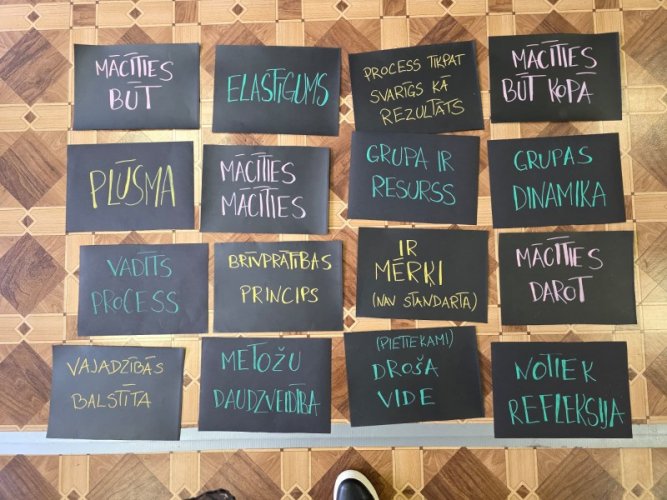
As part of the project “Paths of Connection: Building Support around Youth in the Justice System’, we are working with colleagues to raise awareness of non-formal education and to encourage volunteers from the Prison Service, as well as some prison staff, to incorporate it into their activities within prisons. When discussing young people’s needs and challenges, and the obstacles we encounter in our work, many specifically mention systemic challenges linked to the prison environment, structures, authorisations and so on. And here, non-formal education will not be a panacea. These are issues that must be addressed through awareness-raising and advocacy. At the same time, we must work with young people within the justice system. Their needs are many and varied, and this is precisely where non-formal education comes in. In this project, people who work with young people learn the basic principles of non-formal education and theories of group dynamics, explore a variety of methods, and also plan how to apply these in their work.
As the project title suggests, our work helps to build healthier relationships and communication with these young people. Is it easy? Of course not. Is it necessary? More and more so. This is also evident from the participants’ feedback from the first training sessions:
“I learnt new techniques and approaches for designing better training programmes.”
“The most valuable aspects were the practical tools for team-building, the role of games, and debriefing after the activity.”
“A major benefit was learning to accept myself and allowing myself to be authentic whilst acting as a group facilitator.”
The project has only just got off the ground; there is still a great deal of training ahead, both locally and internationally. However, it is already clear that the outcome will be worth the effort put in. Although the system is changing and developing slowly, working with young people is needed right now. It is therefore very encouraging that our project participants are keen to learn more and, most importantly, to apply this experience when working with one of the most challenging and marginalised groups of young people.
Non-formal education trainer and volunteer at Liepaja prison
Linda Ulane
The project “Paths of Connection: Building Support around Youth in the Justice System” is funded by the European Union. The views and opinions expressed herein are those of the author alone and do not necessarily reflect the views of the European Union or the Mobility and EU Programmes Agency. Neither the European Union nor the granting authority accepts any responsibility for them.