Flower Power in Abava Valley meadows ( Part 2)
The course of the exchange was pretty strongly influenced by the rain that accompanied us throughout the week. Participants slept in tents, but there were tents that were soaked as early as the first night (We now know that not all our tents are good enough). Tluckily there was a possibility to move indoors indoors for those who were really uncomfortable. The weather also affected that there was no warm water in outdoor showers because there was no sun to warm it up. That circumstance was scaring me that at some point there would be a wave of frustration. But no. There were even those who said they could still sleep in that tent for a week because you weren't already raising a tent at home, and saw this as a once-in-a-lifetime experience. There were participants who said they wanted to leave on the first morning, but then appreciated the possibility of being so much in nature, cutting off from their daily routines and social networks, and that despite the bad weather and insufficient infrastructure, they would love to repeat the experience again. Joint rotation, including kitchen help, cleaning and material preparation, created a special atmosphere not experienced in other youth projects, where participants drive to a hotel where everything is already served.
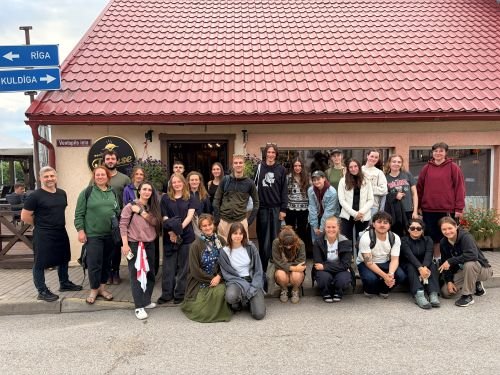
On a day four, I joined in with the intention to introduce participants tothe local community and cultural history as well, and in the afternoon we went on a hike to Sabile. We also visited the Pedvale Open Air Museum of Art, where we just looked in but didn't enter because we had been wet and just wet for 4 days already. I wanted to save them a little bit. We went to see Padvalel from both sides, saw some exhibits, then talked about the days of the Duchy of Courland and the shipbuilding and wine brew of the Curionians (former inhabitants of this region). The youngsters found that without the wild, Sabilée even has whole 3 shops and a stylish souvenir shop. That was important to them, too. They craved for crisps and other unhealthy things. We also visited the Sabile Synagogue, a Tourist Information Centre and art gallery on its premises. With the permission of an employee, Lithuanian Member Victoria, as a professional pianist, also played a little to us while we watched the sculptures on display there. We had dinner at the only Sabiles restaurant, the Resto terrace, where we were welcomed very hospitally. We mixed a little with orders, someone ate more, someone had to order extra. But the landlord was so lovely that we were invited to a picture together and then put a very nice reference on their social networks, mentioning both the project and the fundraisers.

The fifth day was finally sunny, and everyone, including those who had felt debilitated and sick in the days before, was 100% prepared to take a boat trip from Kandava to the rafts or to the Sabile. Most rowed all the way to Sabile. Young people boating for the first time in their lives, too. Somebody was slower, somebody was quicker, but everybody got on and recognised that day as the best in the whole exchange. I don't know if boating counts as a non-formal learning method, but no one was prepared to give it up. Somewhat missed the briefing on how to amend that boat, but everyone seems to have coped without incident.
The incidents began after getting off the boat.

Everyone is already at the dinner table, but we are missing 4 participants from Georgia and Poland. The WhatsApp chess comes with a cry for help saying there was an emergency situation and the girls were in Sabile. I'm already throwing crosses — I don't want to take anyone to the hospital now. But the blame lies with the mobile phone of a Georgia youth group leader who has disappeared in the middle between a store, public toilet and a road home. After several attempts, the number can be dialed. A bus driver who takes the route Riga-Sabile-Kuldiga-Liepaja has found the phone in a public toilet and taken it to save it from drowning in that hole where no one wants to get to. We find out the driver will be in Sabile the next day at noon 18.40. So the Georgian phone with the bank card behind the cap was taken fort a 24-hour trip around Latvia and had seen it more than the Georgian Mari herself. We recovered the phone and the bank card and all was good. Good and honest people are in this world and in fact we owe huge credit to the driver whose name we never knew.
On the last day, once again, young people are bracing themselves for the final scoreboard - groups explore who is recorded in the notebooks, marked, photographed on phones, and created a draft of the Abava Valley meadow Catalogue. Meanwhile, colourful Youthpass certificates have been printed in the capital, which we talked about already on the first day of the exchange - you can get it if you remember the voice of the person standing behind you is ready to hand it over. Everyone gives feedback to each other and ends up completing both the official European Commission report and my evaluation questionnaire, which reads feedback from participants.

And thinking about all that week together and always being able to do more and better and maybe missing another method for diversity and maybe in group work they bagged too little and should have put on more and more etc, but then they leave and what remains is:
Food for which own our gratitude to our chefs Edite, Dave and Alexander:
Emilija (Latvia): “Although I'm not vegetarian, the food was great - every meal was delicious and satiety, and I never got the feeling that there would be too little food.”
Vahagn (Georgia): “I don't mind food at all, it's just not what I usually eat. It was a big challenge for me but I'm excited to have done it because everything needs to be tried.”
Integration in a group:
Gineta (Lithuania): 'I felt noticed and important, my opinion mattered, plus I felt really safe. Every act was different and something new, thank you.'
Jana (Slovenia): “Everyone was very open and it was easy to work with them; the language barrier was hardly felt at all, we really developed a good contact.”
Stella (Latvia): 'I loved the activities on offer, which were fun, and I also learned new things about our nature. Because I'm more of a quiet and anxious personality, I found it harder to talk to new people, but as soon as I managed to make contact with someone, I really enjoyed it. Besides, people turned out to be much more responsive and had much more fun talking to them than I expected. ”
Activities:
Emilija (Latvia): “I would just extend it because I thought it was too short - I wasn't ready for it (the exchange) to end yet.”
Matic (Slovenia): 'the exchange programme was great - it was my fifth and probably the best so far. I also tried to do everything I could, not only in relation to the specific tasks, but also in order to promote the common atmosphere and the well-being of every participant. ”
Adriana (Latvia): “It was great to cut off from technology and just start doing analog things again and learn a lot of new”
Milda (Lithuania): 'I enjoyed spending time outside the venue as well. Plus, it was nice to put together what we'd learned about plants by creating closing posters. ”
Viktorija (Lithuania): “I loved doing artistic activities and spending time in nature on a boat ride.”
Pia (Slovenia): “I loved that we could express ourselves through art, spend time in the fresh air and that these activities helped relieve stress.”
Jacob (Latvia): “There's always room for improvement, perhaps you should have filled the days better with afternoon sessions (after 17.00), although it was nice to have more free time coming together because in those moments the youngsters could spend time together and get to know each other.”
Place:
Vahagn (Georgia): “I loved the place a lot, it's not even possible to describe it in words - nature is charming. The weather prevented us from doing many activities, but it's nothing because I love the rain. Besides, I'd never seen such a bright night before. It was also very interesting.”
Text by Agatha Babin,
youth exchange support person
Photos: Adriana Lešinska
participant in youth exchange
The youth exchange “Flower power” was carried out exclusively within the framework of the Radienvironment itself, as part of the annual Erasmus+ accreditation, and was attended by partner organisations: Zielone Ogniwo (Poland), Ambitia Institute (Slovenia), Tavo Europa (Lithuania), Georgian Youth for Europe (Georgia)
Funded by the European Union. The views expressed reflect only the views of the author and do not necessarily reflect those of the European Union or the Agency for Mobility and EU programmes. Neither the European Union nor the granting authority takes responsibility for them.