Flower Power in Abava Valley meadows
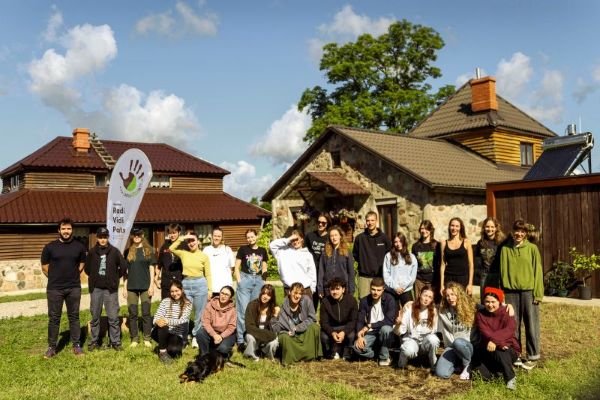
It has been two weeks since 25 participants of the youth exchange “Flower Power” have left the beautiful grasslands of the Abava Valley and returned to their homes in Riga, Kekava, Kazdanga, as well as Slovenia, Poland, Lithuania and Georgia. But let's start everything from the beginning.
More than a year ago, in January, just on my birthday, I took part in a seminar of the NGO “Party Latvia” (Eng. Half of Latvia) on the protection of Latvia's forests and the preservation of biodiversity, and on that day I had a nostalgic memory of youth exchanges, which in 2008 and 2009 Radi Vidi Pats carried out in Pape Nature Park. I also thought about being more and more removed from nature, spending time on screens, school benches and different systems, and forgetting about such simple being, enjoying a moment, and being part of nature. Although we travel more and more, nature in Latvia is also very beautiful, healing, diverse and I see it as I watch the Abava Valley slope and those 7 hectares of flowering meadow, which looks very different in July than in May. Could we have a summer camp, any kind of event for young people? “Yes, we have Erasms + accreditation, in which we are expected to have an exchange in the Activity plan of 2026”, Linda, who is responsible for the activities carried out under accreditation, tells me. But she also says, “But you know that youth exchange has to be implemented and planned by the young people themselves, not by you?” I know, I know. I'll tell them my vision and see if anyone's interest at all.
The first thing that occurs to me is the son of my acquaintances, whom I have known since birth, and who himself has been a volunteer in Georgia, at the Rustavi Scout Center. A call to Jēkabs – “Yes, great, I am in. What do we start with? I' ll make a call, offer my study mates studying chemistry and also call for participants via social networks. We said – Jēkabs would look for young people and I would look for partners abroad. We certainly also needed Georgians, and also those who can travel green, because our accreditation requires at least half of our activity participants to travel green and not fly by plane.
We found everyone, we also refused to some, discussing and objecting for a long time, because there were a little more applications than we needed. 'Both new partner organisations and those who have been participating in our projects for many years, and Slovenians we work with thanks to the Infromagiovaninet network coordinated by the organisation from Sicily, have responded.
We formed the exchange frame with the Latvian group, but the content of non-formal education was filled in it by the leaders of all youth groups communicating together even before the activity, as well as in the evaluation of each day. Day one also began with everyone having to put on a dome cover together, under which we worked during the subsequent exchange.

Afterwards, the first day was devoted to both getting to know each other and group building. Admittedly, there was an incredibly positive impression already at the first evening of arrivals – young people were very friendly and approaching each other and talking together. Those who arrived sooner, like already locals, welcomed the other participants, who arrived to Sabile on July 5 and gradually joined in and sat at a shared dinner table. There were also participants who arrived by car late at night, but they, too, were welcomed and welcomed with warmth from everyone else.

It's easy to think you'll let young people into a green meadow and they'll know what to do about it. However, we also decided in favour of attracting a couple of know-how. One was an experienced environmental guide Jānis Šlūke, with whom Radi Vidi Pats has collaborated in the early years of its activities, organising camps, exchanges and volunteering in Rucava, Pape and the Kemeri National Park. The nostalgia played here again: “Well Jāni, don't you want to repeat something with us again after so mant years?”
Jānis told youngsters about the state of play in conservation policy in Europe, drawing up examples from the countries of the participants and also involving the young people themselves in finding answers to questions about how many national parks there are in each country, how many percent of the country's areas are protected, which are the most vulnerable and more disappearing habitats? Grassland! And we are in Abava Valley meadows, a Natura 2000 site that is also at risk in both the Latvian and European context. Then it was all looked at on maps of different magnitude as well. And finally, young people were given information about different plant families, how to recognize them, as well as an app by which they went in small groups to explore what was then growing in the neighborhood, as well as to collect plants to make prints of them with a particularly special and ancient device that Jānis had purchased from antique shop. Interesting that in the end what several young people admitted they would have liked to still listen and learn more data, theory, etc. There were others who were more approached by the artistic section.


The other guest was Ginta Ernštreite, whom we had known as one of the organisers of the Give & Get Festival, where Radi Vidi Pats had once organized its activities. Ginta uses a wide variety of plants in her practices, both when making various infusions, jams, and when making herbariums, paper, plant batics, herbal preparations, jewellery, scented wood, etc. Ginta's attitude is more esoteric, folkloric about how dialogue is formed with each plant or not, and there are plants that help one person and others not. On Wednesday activities, participants engaged in paper preparation, tie dye and also getting to know Latvian signs by painting them on their faces or burning them in wood pieces.


The sequel will follow in Part 2.
Text by Agatha Babina,
youth exchange support person
Photos: Adriana Leshinsky,
participant in youth exchange
The exchange of young people “Flower power” was carried out exclusively within the framework of the Radi environment itself, as part of the annual Erasms + accreditation, and was attended by partner organisations: Zielone Ogniwo (PL), Ambitia Institute (SLO), tavo Europa (LT), Georgian Youth for Europe (Gea)
Funded by the European Union. The views expressed reflect only the views of the author and do not necessarily reflect those of the European Union or the Agency for Mobility and EU programmes. Neither the European Union nor the granting authority takes responsibility for them.