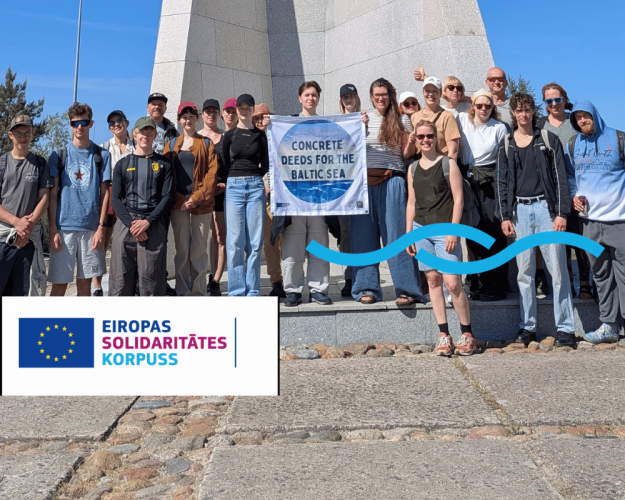
Baltic Sea Guardians in Liepāja: How two weeks of volunteering change your perspective on the environment, the future, and yourself
In June this year, 10 active and curious young people from across Europe gathered in Liepāja and along its coast to take part in the European Solidarity Corps (ESC) volunteering project "CoDeSea" activity "Baltic Sea Guardians", hosted by the association "Radi Vidi Pats". Over two intensive weeks, the volunteers not only joined hands-on environmental actions, but also discovered the powerful impact of community, non-formal learning, and personal growth.
Why Does the Baltic Sea Need Our Protection?
The Baltic Sea is unique because it has a very narrow connection to the ocean, receives a vast amount of fresh water, and is surrounded by highly industrialised countries—making it one of the most vulnerable seas in the world. During the project, the volunteers looked closely at the environmental challenges facing our coastline:
A 30-Year Water Renewal Cycle: The Baltic Sea is an almost completely enclosed body of water. It takes around 30 years for its water to fully renew through the Danish straits (Skagerrak and Kattegat), which means every gram of pollution that enters the sea stays there for decades.
Eutrophication and "Dead Zones": Excessive nutrients (nitrogen and phosphorus) cause heavy blue-green algal blooms. As these algae die and decay, oxygen is stripped from the seabed, creating "dead zones" where marine life cannot survive.
Plastic and Microplastic Pollution: On Karosta beach, the volunteers carried out a detailed waste monitoring survey along a 200-metre stretch of coastline, sorting and counting every item found. The gathered data showed that most coastal litter consists of single-use plastics and synthetic materials that break down into microplastics and enter the food chain.
The participants did more than just gather data; they turned their findings into accessible formats for the public. They created an educational quiz about the Baltic Sea, designed an informative poster about environmental solutions, and helped organise the Ezerkrasts neighbourhood's very first community picnic to share their knowledge with Liepāja residents.
What Do the Young People Say About the Project?
The European Solidarity Corps gives young people an invaluable opportunity to travel, learn in a non-formal setting, discover leadership skills, and make friends across Europe. Here are some of their highlights:
"Community is power. I believe the learning we get from these projects is practically more useful than a university degree... This kind of collaborative learning brings out the best in us and helps us reach our full potential."
— Tahiti (Finland)
"This project was crucial for me to practically and visually experience that I—just like everyone else—have a responsibility to act sustainably, stop littering on beaches, and educate others both locally and across Europe."
— Leif (Germany)
"I learned to completely calm my nervous system during this project. I stopped overthinking, panicking, and feeling stressed. I found a sense of peace in my life and noticed that I am the best version of myself when surrounded by nature and community."
— Tahiti (Finland)
"I left the project knowing specific scientific facts about the Baltic Sea that were completely unknown to me before. I am returning home with real proof and clear takeaways."
— Aurora (Italy)
"Living and working alongside people from different countries broadened my horizons—I learned to see different approaches and viewpoints... I discovered that despite our differences, we have so much in common."
— Ulrike (Germany)
"Communication between the volunteers was easy and natural. When communicating in English wasn't straightforward, we tried to help each other get the message across using our native languages or gestures."
— Aurora (Italy)
"I realised that I really enjoy working in a team. It allows us to complete the work even if a teammate isn't feeling well—others can step in and take care of them, so everyone is looked after and everybody benefits."
— Leif (Germany)
"I took the initiative and led the process of creating the project poster and organising the community event. I learned how to solve problems, work in a team, and manage time even under tight deadlines."
— Ulrike (Germany)
"Our morning circles, where we journaled every day, were the best form of creative expression. It was a very inspiring and wonderful way to start the day. I became curious not only about my environment and the people around me, but also about myself."
— Tahiti (Finland)
"The confidence and strong desire to communicate gained during the project helped me completely overcome the language barrier. It was an unforgettable experience that inspired me to keep learning and participate in similar projects in the future."
— Marat (Ukraine)
"The experience made me feel more confident about how I want my life to look and what I need to do to get there."
— Tahiti (Finland)
Oleksii's Story: From Hands-On Volunteering to Environmental Anthropology
One of the participants—Oleksii Tiurin from Ukraine, who studies anthropology—highlighted in his reflection essay how these two weeks had a lasting impact on his professional and personal journey:
"At the association 'Radi Vidi Pats', over a two-week period, I took part in cleaning up and investigating pollution along the Baltic Sea coast. This volunteering project gave me practical experience of researching environmental pollution; more specifically, it taught me how to engage and lead a group of people with diverse backgrounds in quantitative research and discussions on pollution, using the coastline of Liepāja and the Baltic Sea as a case study.
After this, I became even more keen to continue exploring issues of the environment and consumption within the framework of anthropological research. I was able to discuss with various people how the materiality of the Baltic Sea landscape shapes social relations and fosters an emotional attachment for solving issues, as described by Tilley in her work about landscapes (2017). It was precisely this combination of practical experience and theory that motivated me to continue my studies in environmental anthropology.
For me, it was a really good start to my volunteering career and a logical continuation of my career as an anthropologist. I am grateful to the Radi Vidi Pats team for the opportunity to demonstrate my ability to work as part of a team in unfamiliar circumstances, yet with a single aim: to help improve people's quality of life by assisting with events aimed at cleaning up the environment. I hope this organisation will carry out its future plans in this area to the best of its ability and give other young and ambitious people the opportunity to turn their ideas into reality, just as it did for me."
A Unique Opportunity for Every Young Person
The "CoDeSea" project and the "Baltic Sea Guardians" activity proved that even in two weeks, it is possible to achieve great things—cleaning the coastline, contributing to science and society, and experiencing personal transformation along the way.
Taking part in European Solidarity Corps projects gives young people the freedom to step out of their comfort zone, learn new languages, explore different cultures, and realise that small actions in a local community create big changes across Europe.
The association "Radi Vidi Pats" sends a warm thank you to every volunteer for leaving their mark on Liepāja (and leaving behind a cleaner beach!), as well as to our lead project partners Allianssi Youth Exchanges for coordinating and for excellent cooperation. Read more about the project and opportunities for the next year here: https://www.nuorisovaihto.fi/allianssi-youth-exchanges/esc-vthpa-baltic-sea/.
This activity is part of the European Solidarity Corps project CoDeSea (Project code: 2023-1-EACEA-VTHPA-101239499), co-funded by the European Union. However, the views and opinions expressed are solely those of the author(s) and do not necessarily reflect those of the European Union or EACEA. Neither the European Union nor EACEA can be held responsible for them.
*EACEA stands for the Education, Audiovisual and Culture Executive Agency.

